
Stay updated with Ledrobit’s latest technological advancements, patent achievements, and global market expansions as we continue to innovate in industrial automation.
In large-scale precast concrete bollard manufacturing, achieving consistent surface quality across every unit has become a major challenge for producers. While production volume continues to increase, customers in municipal construction, landscaping, and commercial projects are demanding higher levels of visual uniformity and finishing accuracy.
For manufacturers supplying hundreds or thousands of identical bollards, quality consistency is no longer only a production requirement — it directly affects delivery acceptance, project appearance, and overall manufacturing efficiency.
Traditional manual polishing methods often struggle to maintain the same finishing results throughout an entire production batch. As a result, automated polishing technology is becoming an increasingly important solution for improving quality control in modern precast concrete production.
In the mass production of precast concrete bollards, differences in surface smoothness, chamfer radius, and overall roundness can easily appear between individual pieces. These variations may be acceptable for small-scale production but become critical in projects requiring a high degree of visual consistency.
Municipal infrastructure projects, landscape developments, and commercial installations often require bollards to maintain the same appearance after installation. Even minor differences in surface finish or edge treatment can result in customer complaints, additional sorting, or costly rework.
The fundamental issue is not simply operator skill. Instead, quality fluctuation is a natural limitation of manual processes where every polishing action depends on human operation.
Manual bollard polishing faces three major challenges when manufacturers need stable quality across large production volumes.
During manual polishing, the applied grinding force varies between operators and can also change throughout a working shift due to fatigue. Different pressure levels directly affect surface smoothness, material removal rate, and final appearance.
Hand-operated grinding relies heavily on worker experience. The movement path, polishing coverage, and processing sequence may differ from one operator to another, making it difficult to reproduce exactly the same surface finish on every bollard.
Manual operation often creates differences in cycle time. Workers may reduce processing time when production pressure increases, causing incomplete polishing, while longer processing may lead to unnecessary material removal.
These variables make batch quality control highly dependent on operator performance, creating challenges for manufacturers aiming for standardized production.
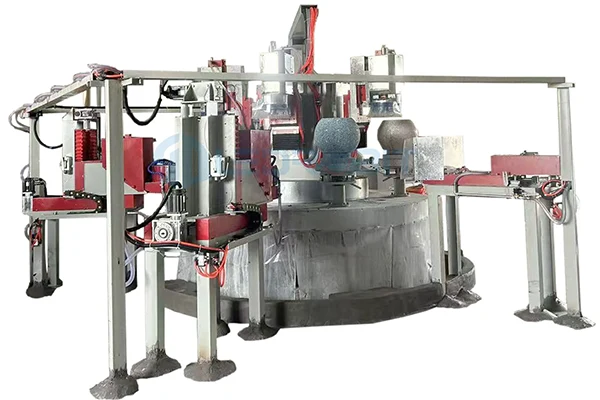
The main advantage of a multi-station bollard polishing machine is the replacement of manual variability with controlled mechanical parameters.
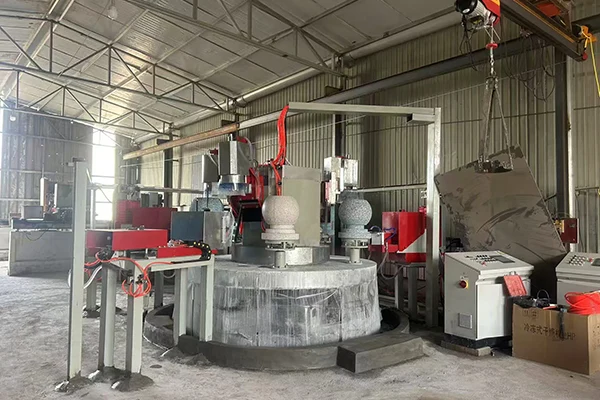
In a 5-station automated bollard polishing machine, each station operates with synchronized feed systems, consistent pressure settings, and standardized processing paths. This ensures that every bollard receives the same polishing conditions throughout the production cycle.
Whether processing the first piece or the fiftieth piece in a batch, the machine maintains the same grinding force, movement pattern, and finishing duration. This creates a predictable production standard that is difficult to achieve through manual operations.
Consistency is closely related to processing time. The automated polishing process establishes a fixed production rhythm, with the grinding cycle controlled at approximately 4 minutes per piece.
This cycle time is determined by machine parameters, including feed rate, spindle speed, and programmed processing path. Unlike manual polishing, where speed changes according to worker conditions, automated equipment ensures that every bollard undergoes the same processing duration.
This machine-controlled approach eliminates common quality issues caused by rushed operations or excessive polishing, helping manufacturers maintain stable finishing standards across large batches.
For concrete bollard finishing, chamfer quality is an important factor affecting overall appearance. Uneven chamfer angles or inconsistent edge treatment can become noticeable when multiple bollards are installed together.
The supporting chamfering equipment uses a mechanical profiling and positioning system to control the processing path, maintaining a chamfer radius tolerance within ±1mm.
This level of repeatable precision ensures that bollards from the same production batch maintain consistent edge appearance. For projects requiring uniform alignment and visual harmony, mechanical accuracy provides a significant advantage over manual finishing methods.
When selecting automated polishing equipment, manufacturers should focus not only on the finishing quality of a single workpiece but also on the repeatability of the entire production batch.
Three key factors should be considered:
A reliable system should maintain consistent operating parameters across all stations, ensuring every workpiece receives the same processing conditions.
Stable processing time allows manufacturers to achieve predictable output and maintain consistent surface quality throughout long production runs.
Critical processes such as chamfering require precise mechanical positioning to achieve uniform appearance across large quantities of finished products.
For modern precast concrete manufacturers, the greatest value of automation is not only improving the appearance of a single bollard, but ensuring that hundreds of products can achieve the same quality standard.
Multi-station automated polishing technology transforms finishing operations from a worker-dependent process into a controlled manufacturing procedure with predictable parameters, repeatable accuracy, and improved quality management.
As demand for standardized precast products continues to grow, automated polishing solutions will play an increasingly important role in helping manufacturers achieve higher production reliability and stronger market competitiveness.